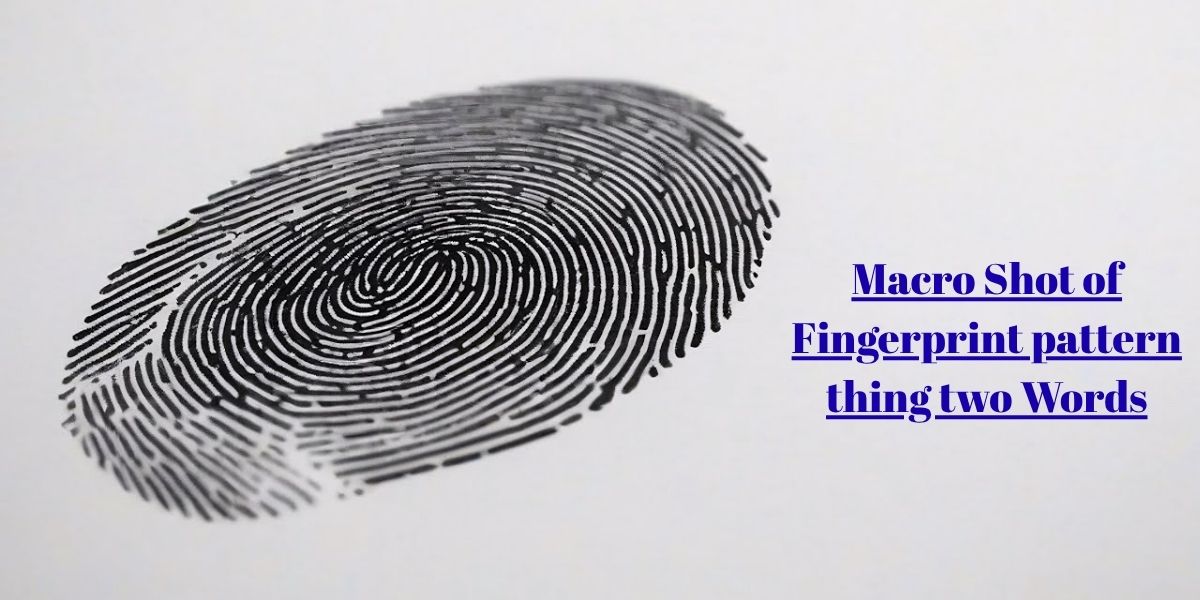
A macro photograph of a human fingertip transforms familiar skin into a complex landscape of raised friction ridges and deep, narrow furrows. Under high magnification, these tiny topographical structures reveal the physical foundation of human tactile sensation and biometric identification.
Beyond revealing visual aesthetics, high-resolution macro imagery captures the precise physical attributes that biometric sensors scan and forensic algorithms analyze. The physical ridges curve, loop, divide, and terminate in unique configurations formed during fetal development.
Fingerprint patterns are categorized into three primary structural families: loops, whorls, and arches. While these macro-level shapes offer an initial classification framework, forensic analysis relies heavily on microscopic ridge characteristics and image clarity to establish individual identity.
The Anatomy of Fingerprint Ridges and Furrows
Friction ridge skin covers the palmar surfaces of the hands and the plantar surfaces of the feet. This specialized skin lacks hair follicles and sebaceous glands but contains a high density of eccrine sweat glands. In a close-up macro photograph, these anatomical structures become distinctly visible across the skin surface.
The primary physical components visible in an extreme close-up view include:
- Friction Ridges: Raised corrugated skin formations that create direct contact with touched surfaces.
- Furrows: Recessed valleys or channels separating adjacent friction ridges.
- Ridge Flow: The continuous directional trajectory and sweeping curvature of ridges across the fingertip.
- Ridge Endings and Branches: Specific points where a friction ridge terminates or splits into two separate paths.
- Ridge Edges: The structural lateral boundaries separating the peak of a raised ridge from the adjacent furrow floor.
Friction ridge skin provides essential traction for gripping objects, aiding tactile perception through localized nervous system responses. From an imaging perspective, a macro photograph records light reflected off three-dimensional skin, meaning lighting angles, shadows, and focal depth heavily influence how distinct the ridges appear.
Understanding this three-dimensional geometry is essential for biometric acquisition. While a photograph captures light reflection, modern biometric readers analyze physical skin elevation, electrical capacitance, or optical refraction across the ridges and furrows.
The Three Main Fingerprint Patterns: Loops, Whorls, and Arches
At a macro level, friction ridges arrange themselves into three primary pattern families. Forensic standards and biometric indexing systems rely on these broad structural categories to sort and process large fingerprint databases efficiently.
The three primary pattern families feature distinct ridge flow behavior:
- Loops: Ridges enter from one side of the impression, curve backward in a loop formation, and exit or tend to exit on the same side.
- Whorls: Ridges form circular, spiral, or complex multi-loop arrangements, typically accompanied by two delta points.
- Arches: Ridges enter from one side of the impression, rise in the center, and exit on the opposite side without recurving.
Historical forensic reference data provided by institutions like the Federal Bureau of Investigation (FBI) and the National Institute of Standards and Technology (NIST) establish general population baseline frequencies for these patterns.
Loops represent approximately 65% of all human fingerprint patterns, whorls account for roughly 30%, and arches are the rarest, appearing in approximately 5% of fingerprints. These percentages serve as historical reference benchmarks rather than fixed global constants, as actual distribution frequencies vary across demographic groups and population samples.
While broad pattern families offer an efficient framework for initial sorting, they do not provide sufficient detail for individual identification. Forensic examiners examine deeper structural features, minutiae points, and ridge edge details within these macro formations.
Ulnar Loops and Radial Loops: The Importance of Hand Orientation
Loops represent the most frequently observed pattern family and are subdivided into two primary anatomical categories: ulnar loops and radial loops. Distinguishing between these subtypes requires knowing the exact hand and digit from which the impression was captured.
The anatomical distinctions depend on bone alignment within the forearm:
- Ulnar Loop: A loop pattern whose ridges flow and open toward the ulna bone, located on the pinky-finger side of the hand.
- Radial Loop: A loop pattern whose ridges flow and open toward the radius bone, located on the thumb side of the hand.
Describing a loop as simply left-facing or right-facing is insufficient for forensic accuracy without context regarding hand orientation. A loop opening toward the left on a right hand represents an ulnar loop, whereas the exact same left-opening loop on a left hand represents a radial loop.
Accurate hand and digit orientation is critical in digital image processing. If a digital macro photograph is mirrored, flipped, or rotated improperly during capture or post-processing, an ulnar loop can be misidentified as a radial loop, corrupting automated biometric search queries.
Plain and Tented Arches: How Central Ridge Flow Changes
Arches represent the simplest yet least common friction ridge pattern group, appearing in roughly 5% of recorded human fingerprints. Within this category, forensic classification separates impressions into plain arches and tented arches based on the specific behavior of ridges passing through the center.
A plain arch features ridges that enter from one side of the impression and flow across with a gentle, continuous wave or rising slope through the center. There is no sharp spike, abrupt break, or downward plunge.
In contrast, a tented arch displays a dramatic central upward thrust where ridges converge sharply, resembling a tent pole or a vertical spike. While a tented arch can share superficial similarities with a loop, it lacks the specific recurving ridge count and core requirements necessary for standard loop classification.
Four Whorl Subtypes and the Ridge Formations That Distinguish Them
Whorls introduce complex circular or spiral trajectories accompanied by two delta points on opposite sides of the pattern. Forensic classification divides whorls into four distinct structural subtypes based on internal ridge geometry:
- Plain Whorl: Contains a complete circuit of ridges that circle a core, with imaginary lines drawn between the two deltas crossing at least one recurving ridge.
- Central Pocket Loop Whorl: Features a tight interior pocket or loop formation enclosed within a broader outer whorl circuit, creating an asymmetrical core structure.
- Double Loop Whorl: Comprises two separate and distinct loop formations that entwine or wrap around each other, each possessing independent shoulders and core centers.
- Accidental Whorl: Encompasses complex patterns combining two different pattern types or unique formations that defy standard categorization under the other three definitions.
Identifying these subtypes requires careful examination of the core and delta regions. A circular-looking feature visible in a cropped macro photograph is insufficient on its own to confirm a whorl subtype without verifying the complete delta configuration.
Ridge Endings, Bifurcations, Cores, and Deltas
Moving beyond broad pattern families, fingerprint examination relies heavily on localized features and reference points. A core marks the innermost focal point or center of a loop or whorl pattern, serving as a primary anchor for fingerprint card orientation.
A delta designates a triangular node area where three distinct directions of ridge flow converge from opposing angles. Beyond these macro landmarks, forensic experts and automated algorithms analyze microscopic minutiae:
- Ridge Ending: The exact point where a continuous friction ridge stops abruptly.
- Bifurcation: The juncture where a single ridge divides into two separate parallel branches.
- Dot: A very short friction ridge fragment resembling an isolated point.
Under the National Institute of Standards and Technology feature-marking framework, different pattern types exhibit distinct core and delta counts. Plain arches possess zero cores or deltas, loops contain exactly one core and one delta, and whorls typically feature two deltas with varying core structures.
Level 1, Level 2, and Level 3 Fingerprint Detail
Modern biometric standards classify friction ridge data into three hierarchical tiers to ensure consistent evaluation across forensic and automated systems. Level 1 detail encompasses overall ridge flow and pattern orientation. While it classifies a print as an arch, loop, or whorl, Level 1 detail alone cannot establish individual identity.
Level 2 detail focuses on individual ridge paths and localized minutiae points, including ridge endings, dots, and bifurcations. This tier forms the bedrock of traditional automated fingerprint identification systems, as the relative spatial arrangement of minutiae remains highly distinct between individuals.
Level 3 detail captures ultra-fine structural attributes, including sweat pore positions along the ridges, incipient ridge formations, and microscopic edge contours. Capturing Level 3 detail requires exceptional image resolution, high contrast, and precise optical focus.
What Pores and Ridge Edges Reveal in a High-Resolution Fingerprint Image
When a macro photograph achieves high optical magnification and precise focus, it exposes Level 3 details, which reside directly along individual friction ridges. These microscopic features offer an additional layer of biological information beyond standard minutiae points.
A high-resolution image captured under ideal lighting reveals specific fine structures:
- Eccrine Sweat Pores: Small circular openings situated along the center of friction ridges that exude moisture, appearing as lighter dots or tiny voids along the ridge line.
- Ridge-Edge Contours: Microscopic variations, notches, and structural irregularities along the lateral boundaries where a raised ridge drops off into a furrow.
- Incipient Ridges: Narrow, thin, and often unformed ridges situated in the furrows between main friction ridges that lack sweat pores.
The Federal Bureau of Investigation (FBI) Criminal Justice Information Services (CJIS) standards highlight the importance of high-resolution acquisition for capturing Level 3 detail. Standard automated fingerprint systems traditionally operate at a resolution of 500 pixels per inch (ppi), which comfortably records Level 1 pattern flow and Level 2 minutiae.
However, capturing reliable Level 3 details such as pore morphology and edge contours generally requires scanning resolutions of 1000 ppi or higher, paired with optimal lighting to prevent shadow distortion.
Digital enlargement alone cannot create Level 3 data. Interpolating or zooming in on a low-resolution or compressed digital image merely magnifies existing pixels, failing to reveal true pore locations or genuine ridge-edge structures.
Why Fingerprint Image Quality Affects Biometric Matching
The performance of automated fingerprint identification systems (AFIS) depends heavily on the quality of the input image. A blurred, distorted, or low-contrast macro photograph can lead to false matches or false non-matches during biometric comparison.
Several physical and optical factors degrade fingerprint image quality:
- Sub-Optimal Resolution and Focus: Inadequate camera sensor resolution or a shallow depth of field that leaves peripheral ridges out of focus.
- Low Image Contrast: Poor lighting that reduces the visual distinction between raised ridges and recessed furrows.
- Skin Condition Issues: Dry skin causing broken ridge lines, or excessively oily skin causing ink or sweat to bridge across furrows.
- Contact Distortion: Excessive physical pressure against a scanner glass that flattens ridges and distorts minutiae spatial coordinates.
- Compression Artifacts: Aggressive JPEG compression that introduces blocky artifacts along ridge edges, creating artificial minutiae points.
To standardize quality evaluation, NIST developed the NIST Fingerprint Image Quality 2 (NFIQ 2) algorithm. NFIQ 2 evaluates operational 500 ppi fingerprint images, assigning a quality score from 1 to 5 that directly predicts automated matching performance.
High-quality images minimize processing errors, ensuring that biometric match algorithms correctly locate genuine ridge endings and bifurcations without being mislead by image noise.
Macro Photography Versus Fingerprint Sensor Capture
While a macro photograph and a biometric sensor capture image both record the surface of a fingertip, they serve fundamentally different operational purposes and rely on distinct imaging principles.
A macro photograph uses camera lenses, ambient or artificial lighting, and optical sensors to create a visual representation of skin surface topography. It offers excellent illustrative value, high aesthetic clarity, and customizable depth of field, making it ideal for forensic documentation, education, and visual analysis.
Conversely, dedicated biometric sensors capture functional data optimized for automated matching algorithms:
- Optical Touch Sensors: Utilize total internal reflection across a prism to record high-contrast images of ridges making physical contact with a glass platen.
- Capacitive Sensors: Measure tiny electrical capacitance differences between conductive skin ridges and air-filled furrows using a micro-capacitor array embedded under a protective cover.
- Ultrasonic Sensors: Send acoustic pulses against the finger surface to measure pressure wave reflections, capturing deep dermal skin layers that resist surface dirt and oil.
A standard macro photograph cannot be directly substituted for an operational biometric sensor template in most secured access systems. Biometric enrollment requires specific file formats, calibrated spatial resolution, standardized compression, and anti-spoofing liveness verification that a passive digital photograph does not provide.
Conclusion
A macro photograph of a fingertip bridges the gap between biological anatomy and digital imaging science. When examining the intricate landscape of raised friction ridges, narrow furrows, and sweeping ridge flow, viewers witness the unique physical structures that define human identity.
Fingerprint examination relies on a structured hierarchy of information. Initial classification begins at Level 1 with broad patterns like loops, whorls, and arches. Forensic analysis then moves down to Level 2 minutiae, such as ridge endings and bifurcations, before exploring Level 3 features like sweat pores and edge contours.
The ultimate utility of any fingerprint image, whether captured through macro photography or a specialized biometric sensor, depends strictly on what the original optical system preserves. Understanding these technical layers ensures accurate analysis across forensic science and biometric security systems.
Frequently Asked Questions
What are the three main fingerprint pattern types?
The three primary families are loops, whorls, and arches. Each category contains specific subtypes that define the overall trajectory and curvature of friction ridges across the fingertip.
What is the difference between an ulnar loop and a radial loop?
An ulnar loop flows and opens toward the little finger side of the hand, aligning with the ulna bone. A radial loop flows and opens toward the thumb side, aligning with the radius bone. Determining the correct type requires knowing the exact hand and digit from which the impression came.
Which fingerprint pattern is most common?
Loops are universally recognized as the most frequent pattern family. Traditional baseline studies estimate that loops account for approximately 65% of all human fingerprints, while whorls represent about 30% and arches comprise roughly 5%.
What are fingerprint minutiae?
Minutiae are localized structural characteristics along the friction ridges. Key examples include ridge endings, where a ridge stops abruptly, and bifurcations, where a single ridge splits into two separate paths. These points serve as primary reference markers for automated biometric matching algorithms.
Can a macro photograph identify a person?
A macro photograph reveals detailed skin topography, but the image alone does not constitute a formal biometric identification. Reliable verification requires standardized image capture, proper resolution standards, and a rigorous comparison process conducted against known reference databases.